www.aljazeerah.info
2026 News
Archives
Mission & Name
Conflict Terminology
Editorials
Gaza Holocaust
Gulf War
Isdood
Islam
News
News Photos
Opinion Editorials
US Foreign Policy (Dr. El-Najjar's Articles)
www.aljazeerah.info
|
Editorial Note: The following news reports are summaries from original sources. They may also include corrections of Arabic names and political terminology. Comments are in parentheses. |
***
The Israeli Occupation Regime Continues to Escalate its War on Iran by the Assassination of Larijani and Soleimani, Targeting Civilian Facilities, Including Gas Facility in Bushahr
March 18, 2026
***
 |
 |
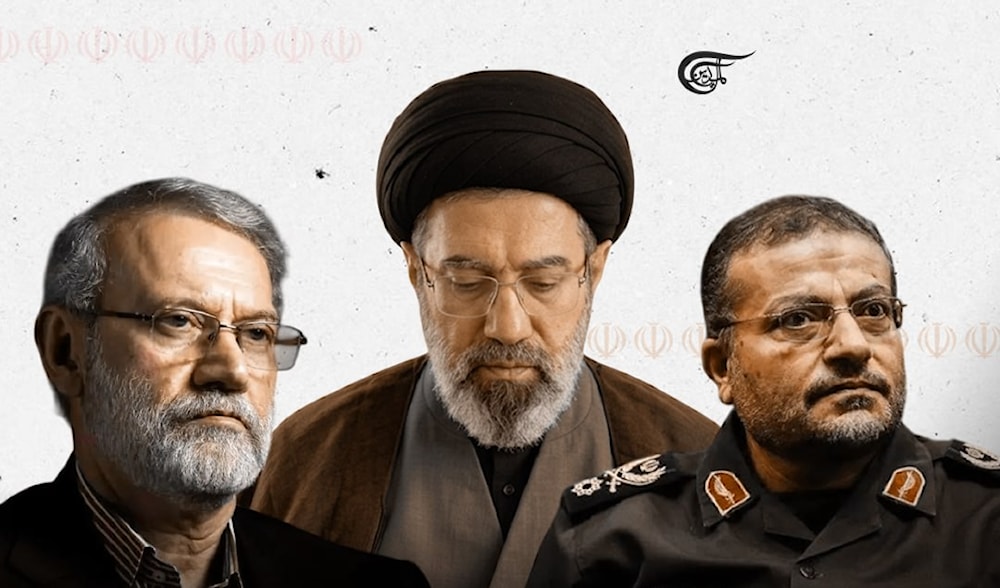
| Iran's leader Sayyed Mojtaba Khamenei mourns the martyrdom of Ali Larijani, his son, and colleagues, as well as Basij commander Gholamreza Soleimani, who were all assassinated by the Israeli air strikes, March 18, 2026. |
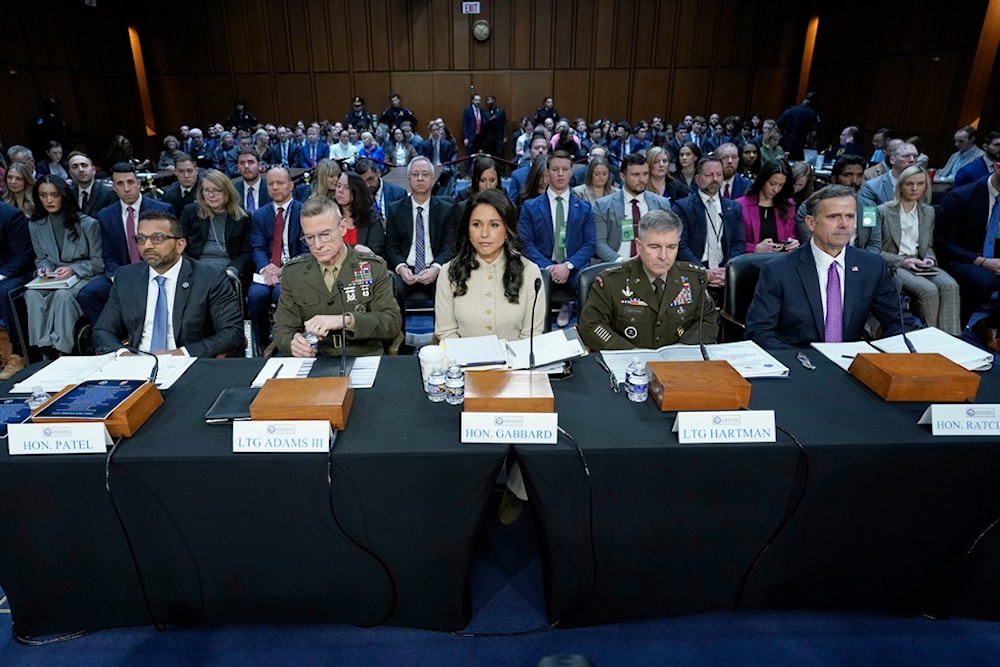
Director of the US National Intelligence, Tulsi Gabbard, stated in Congress that Iran was not rebuilding its nuclear enrichment capabilities, contradicting Trump's justification for the war, March 18, 2026. |
***
Sayyed Khamenei mourns Larijani, Soleimani: Blood carries retribution
Al-Mayadeen, March 18, 2026
Iran’s leader Sayyed Mojtaba Khamenei mourns the martyrdom of Ali Larijani, his son, and colleagues, as well as Basij commander Gholamreza Soleimani, affirming their sacrifice will strengthen the Islamic Republic.
Sayyed Mojtaba Khamenei, leader of the Islamic Republic and Revolution, issued a solemn statement mourning the martyrdom of Dr. Ali Larijani, Secretary of the Supreme National Security Council, his son, and several of his comrades, who were killed in a US–Israeli assassination.
Opening his statement with a verse from the Quran, "Do not consider those who have been killed in the way of Allah as dead; rather, they are alive with their Lord, being provided for", Sayyed Khamenei underscored the enduring spiritual honor of those who sacrificed their lives for the nation.
He eulogized Dr. Larijani as a far-sighted, intelligent, and deeply committed figure, whose nearly five decades of service across political, military, security, cultural, and administrative spheres had made him an exceptional leader in the Islamic Republic.
“The assassination of such a prominent personality demonstrates both his importance and the malice of Islam’s enemies,” Sayyed Mojtaba said. He emphasized that the shedding of their blood will only strengthen the Islamic Republic, and that those responsible for this crime will ultimately face retribution.
The Iranian leader stressed that the strength of the Islamic Republic does not rely on individuals alone, but on a deeply rooted path that continues undeterred despite repeated attacks. He added that the martyrs "safeguard the Islamic Revolution from the traps set by the Zionist enemy and the arrogant United States," and that their sacrifice guarantees victory in this decisive struggle.
He concluded by extending heartfelt condolences to Dr. Larijani’s family, particularly to Ayatollah Sadegh Amoli Larijani, the Chairman of Iran's Expediency Discernment Council, and prayed for the elevation of the departed souls in the sight of God.
Sayyed Mojtaba Khamenei's letter of condolence can be read here:
In the Name of God, the Most Gracious, the Most Merciful
"Do not consider those who have been killed in the way of Allah as dead; rather, they are alive with their Lord, being provided for."
With deep sorrow, I received the painful news of the martyrdom of Dr. Ali Larijani, Secretary of the Supreme National Security Council and Representative of the Leader in the Council, his honorable son, and some of his colleagues.
Dr. Larijani was a scholar and a visionary, intelligent and deeply committed, with extensive experience across political, military, security, cultural, and administrative fields. Nearly five decades of service in the various layers of the Islamic system had made him a truly distinguished figure.
Undoubtedly, the assassination of such a personality underscores both his significance and the enmity of Islam’s adversaries toward him. Let the enemies of Islam know that the shedding of this blood at the roots of the Islamic system will only strengthen it further. Indeed, every drop of this sacred blood carries its own measure of retribution, which the criminal killers of these martyrs will soon face.
I extend my heartfelt condolences to his esteemed wife, children, and family, and particularly to Ayatollah Amoli Larijani, and I pray to Almighty God for the elevation of the ranks of these departed souls.
Sayyed Mojtaba Hosseini Khamenei 26 Esfand 1404
Sayyed Khamenei eulogizes Martyr Gholamreza Soleimani
Sayyed Mojtaba Khamenei also issued a message of condolence following the martyrdom of Commander Gholamreza Soleimani, head of the Basij Organization, who was assassinated on Tuesday in a US–Israeli attack.
In his statement, the Leader expressed deep sorrow over the loss, stressing the assassination is a reflection of the enemy’s fear of the Basij and its role within the Islamic Republic. He emphasized that Soleimani had spent years in dedicated service and struggle, gaining extensive experience in defending the nation.
The targeting of such figures, Sayyed Khamenei reiterated, underscores the importance of the Basij and the enemy’s inability to confront it directly, characterizing the act as one driven by fear and hostility.
The Leader extended his heartfelt condolences to the martyr’s family, his colleagues in the Islamic Revolution Guard Corps, and all Basij members, affirming confidence in the continuation of their path and mission.
In the Name of God, the Most Gracious, the Most Merciful
"Among the believers are men who have been true to their covenant with Allah; among them are those who have fulfilled their vow, and among them are those who await, and they have never altered in the least."
The sorrowful news of the martyrdom of Commander Gholamreza Soleimani, head of the Basij Organization, has caused deep grief and profound sorrow.
He had long been active on the battlefield, striving in the path of God, gaining extensive experience through years of dedicated service. The assassination of this devoted commander once again underscores the great significance of the Basij and reflects the deep fear harbored by the malicious and cowardly enemy in confronting it.
I extend my heartfelt condolences on this painful loss to the esteemed family of this noble martyr, to his colleagues in the Islamic Revolution Guard Corps, and to all Basij members. I pray that Almighty God grants him the highest rank and elevates his status.
Sayyed Mojtaba Hosseini Khamenei 26 Esfand, 1404
Sayyed Khamenei mourns Larijani, Soleimani: Blood carries retribution | Al Mayadeen English
***
US intelligence disputes 'imminent nuclear threat' from Iran
Al-Mayadeen, AFP, March 18, 2026
US intelligence says Iran was not rebuilding its nuclear enrichment program after last year's 12-Day War, contradicting Trump’s justification for this war.
US intelligence assessed that Iran was not rebuilding its nuclear enrichment capabilities following last year’s US–Israeli attacks, contradicting the "justification" cited by President Donald Trump for the ongoing war on Iran.
The findings were presented by Director of National Intelligence Tulsi Gabbard, as she and other officials testified before Congress, offering a mixed picture of the war’s background and consequences.
In prepared testimony to the Senate Intelligence Committee, Gabbard said that “Operation Midnight Hammer,” the June 2025 US strike on Iran's nuclear facilities, had “obliterated” Iran’s nuclear enrichment program.
“There has been no efforts since then to try to rebuild their enrichment capability,” she wrote, though she did not repeat the conclusion during the public hearing. When pressed by lawmakers, she said she had not fully reviewed the testimony but did not dispute its contents.
Donald Trump has repeatedly justified the aggression on Iran in collaboration with "Israel" by citing an “imminent threat,” maintaining that Iran was close to developing a nuclear weapon despite earlier claims that US strikes had destroyed its nuclear infrastructure.
However, the International Atomic Energy Agency and most independent observers have not supported assertions that Iran was on the verge of producing a nuclear bomb, particularly as negotiations with US envoys were ongoing before the escalation.
Internal dissent and political backlash
Gabbard, who previously opposed war with Iran during her time in Congress, faced criticism from Democrats who argued that the administration had failed to demonstrate a new or imminent threat.
Her senior aide, Joseph Kent, resigned in protest, stating that Iran posed no immediate danger and accusing Trump of being misled by “Israel” and media narratives.
Democratic Senator Michael Bennet criticized the shift in US policy, saying Trump had reversed his pledge to avoid acting as “the policemen of the world.”
Gabbard told lawmakers that while Iran had suffered significant damage during weeks of attacks, including the killing of senior leadership figures, its governing structure remains intact.
The US intelligence community assessed that Iran’s system is “largely degraded” but still functioning, warning that it could pursue a long-term effort to rebuild military, missile, and drone capabilities if it survives.
Russia and China assessments
Beyond Iran, Gabbard said US intelligence believes Russia retains the upper hand in its ongoing war against Ukraine, with Moscow expected to continue a prolonged conflict despite ongoing negotiations.
She also warned of risks of escalation that could potentially lead to nuclear confrontation.
On China, Gabbard said Beijing is rapidly modernizing its military with the aim of being capable of taking Taiwan, though it likely prefers achieving reunification without direct conflict.
Trump is expected to travel to China in the coming weeks, after postponing the visit due to the ongoing war in the Middle East.
US intelligence disputes 'imminent nuclear threat' from Iran | Al Mayadeen English
***
War on Iran may actually cost the US trillions: The Intercept
Al-Mayadeen, The Intercept, March 18, 2026
Experts warn Trump’s war on Iran could cost trillions, far exceeding Pentagon estimates, with long-term debt and veteran care driving expenses.
The financial cost of the US-Israeli war on Iran is rapidly escalating, with experts and officials warning that initial Pentagon estimates significantly understate the true scale of spending.
While the Pentagon has offered early figures in the tens of billions, analysts, lawmakers, and officials cited by The Intercept say the real cost trajectory could reach hundreds of billions in the short term and trillions over time.
The Pentagon stated that the US spent approximately $11.3 billion in just one week of operations, a figure echoed by Trump's economic advisor Kevin Hassett, who placed the cost at $12 billion.
However, officials and experts told The Intercept that these figures represent only a partial accounting.
They estimate the war is consuming between $1 billion and $2 billion per day, roughly $11,500 to $23,000 per second, with the total potentially reaching a quarter trillion dollars in the coming months.
Jules Hurst III, acting comptroller of the War Department, described the Pentagon’s estimate as a “ballpark number,” adding that a more comprehensive figure would be submitted in a supplemental budget request.
War costs could reach hundreds of billions
Short-term projections cited by The Intercept suggest that the war, which is now in its third week, could cost between $60 billion and $130 billion.
A five-week war could reach $175 billion, while eight weeks could push costs to $250 billion.
A government official, speaking on the condition of anonymity, acknowledged the uncertainty of these figures to The Intercept, saying that “It’s a back-of-the-napkin estimate,” while another official told the outlet, “They really have no idea of the real cost.”
Hidden costs beyond battlefield spending
Beyond immediate expenditures, long-term costs are expected to far exceed short-term projections.
Linda Bilmes, a public policy professor at Harvard Kennedy School, told The Intercept that the war could surpass $50 billion within weeks, with the overall cost eventually reaching into the trillions.
Bilmes pointed to long-term obligations such as veterans’ benefits and interest on debt as key drivers of future spending.
Drawing comparisons to the Iraq War, she noted that early estimates of $40 billion ultimately expanded to around $8 trillion over time.
Lawmakers question strategy and transparency
US lawmakers have raised concerns about both the cost and the lack of clarity surrounding the war.
Representative Sara Jacobs told The Intercept, “We haven’t gotten sufficient details in public or behind closed doors about the strategy, the objectives, the length of the operation, or how much this will cost taxpayers,”
“The American people are demanding an end to this illegal war to prevent more killings of children, retaliation against U.S. service members, skyrocketing costs to U.S. taxpayers, and yet another endless war,” she added
Military buildup and early costs underestimated
Analysts say early Pentagon estimates exclude key expenditures, including the pre-war military buildup in the region.
Elaine McCusker, a former Pentagon budget official, estimated that preparations alone cost around $630 million.
Initial operational estimates also fell short. A breakdown by the Center for Strategic and International Studies (CSIS) placed early costs at $3.7 billion, but later updates raised that figure significantly, with officials revealing that $5.6 billion in munitions was used in just the first two days.
An updated CSIS estimate cited by The Intercept put the cost at $16.5 billion by the 12th day of operations.
Economic and human costs expand over time
Beyond immediate military spending, the war is expected to generate substantial long-term financial and human costs.
Bilmes warned that exposure of US troops to hazardous conditions could result in significant future liabilities under veteran care programs.
She estimated that disability claims alone could add around $600 billion over time, depending on claim rates.
Rising public debt is another concern. Bilmes noted that US war spending has historically been financed through borrowing, increasing long-term interest obligations and placing additional strain on federal budgets.
Political divide over funding the war
The growing financial burden has intensified political divisions in Washington.
House Minority Leader Hakeem Jeffries criticized the administration’s approach, stating that it had not justified the scale of spending involved in the war.
Meanwhile, Representative Rob Wittman expressed support for additional funding, citing broader military readiness needs.
Policy analyst Gabe Murphy of Taxpayers for Common Sense told The Intercept that Congress should not approve further funding without proper authorization, warning of the broader economic consequences.
“Taxpayers deserve answers on the precise costs and timeline for this war,” Murphy said. “‘Indefinitely’ isn’t an answer.”
War on Iran may actually cost the US trillions: The Intercept | Al Mayadeen English
***
US, 'Israel' attack gas facilities at Iran's South Pars field
Al- Mayadeen, March 18, 2026
Tasnim news agency reports that US and Israeli forces attacked oil industry facilities at Iran's South Pars field and Asaluyeh region, marking an escalation in the targeting of the country's energy infrastructure amid ongoing regional war.
Oil industry facilities at the South Pars field and in the Asaluyeh region in southern Iran have been attacked, the Tasnim news agency reported on Wednesday.
According to reports, US and "Israel" attacked gas facilities about an hour ago.
Iranian state TV reports that phases 3, 4, 5, and 6 of the South Pars gas field were struck, marking a significant hit to key energy infrastructure. Israeli occupation regime officials confirmed that they bombed Iran’s largest natural gas processing facility in Bushehr Province this morning, while Iranian reports say strikes hit South Pars and Asaluyeh, forcing several phases offline.
European gas prices jumped 6% after the attacks on Iranian gas facilities, surpassing $650 per 1,000 cubic meters for the first time since March 9, according to trading data.
Context: Strategic importance of South Pars and regional energy war
The South Pars field is the world's largest natural gas field, located in the Gulf area and jointly owned by Iran and Qatar. The attack on facilities in the Asaluyeh region represents a significant escalation in the targeting of Iran's energy infrastructure.
The attacks come amid a widening energy war across the region. Since the United States and "Israel" launched their aggression against Iran on February 28, Tehran has been targeting the energy infrastructure of its Gulf Arab neighbors as part of a strategy to drive up oil prices and put pressure on Washington.
The price of Brent crude oil, the international standard, has surged more than 40% since the start of the war, remaining stubbornly over $100 per barrel.
Previous attacks on Iran's oil infrastructure
The US previously attacked Iran's Kharg Island in the Gulf region, the country's main oil terminal.
On Friday, US President Donald Trump said American forces "obliterated" targets on Kharg Island, though he stated they "left its oil infrastructure alone for now."
However, Trump warned that if Iran continues to interfere with shipping in the Strait of Hormuz, he would "reconsider his decision not to 'wipe out the Oil Infrastructure.'"
Nuclear dimension
The attacks on energy infrastructure follow a missile attack on Tuesday evening that hit the premises of the Bushehr Nuclear Power Plant, located in the same province as the South Pars field.
The International Atomic Energy Agency confirmed it had been informed by Iran that a projectile struck the plant, though no damage to the facility or injuries to staff were reported. The IAEA's Director General, Rafael Grossi, reiterated his call "for maximum restraint during the conflict to prevent risk of a nuclear accident."
Iranian state television and the state-run IRNA news agency both reported on the attack targeting facilities at Asaluyeh. It remains unclear precisely which facilities were hit or the extent of the damage.
Iran threatens retaliation against US energy infrastructure
The Khatam al-Anbiya Central Headquarters vowed to destroy all US-related energy infrastructure in the region and turn it into a "pile of ashes" if Iran's oil, economic, and energy infrastructure is attacked.
Kharg Island is located about 30 kilometers from the coast, containing the largest oil export terminal in Iran, through which about 90% of its crude oil exports pass, according to a recent report issued by the American bank JPMorgan.
The island remains a critical hub for Iran’s energy sector, making any escalation around it a potential factor in global energy market volatility.
US, 'Israel' attack gas facilities at Iran's South Pars field | Al Mayadeen English
***
War on Iran turns shipping into chaos as costs and risks surge
Al-Mayadeen, The Financial Times, March 18, 2026
The war on Iran has disrupted global shipping routes, sending freight costs soaring and forcing carriers to reroute cargo
The ongoing US-Israeli war on Iran has thrown global shipping networks into disarray, with industry players describing conditions as a “wild west” marked by soaring costs, disrupted routes, and mounting uncertainty.
Shipping companies and customers report that escalating tensions in the Gulf have forced carriers to suspend bookings, reroute cargo, and impose significant additional charges, placing growing pressure on global trade flows.
The scale of disruption has led industry figures to characterize the situation in stark terms.
David Ozard, general manager at John Mason International, described to the Financial Times the current environment as chaotic and coercive, “At the moment it’s a complete wild west,” adding that customers are being compelled to absorb rising costs, “If we don’t, shipping lines put our accounts on hold and hold us to ransom.”
Containers bound for West Asia are increasingly being diverted to alternative ports, leaving customers responsible for unexpected storage and import costs.
Strait of Hormuz tensions disrupt global trade
The effective closure of the Strait of Hormuz following US-Israeli strikes on Iran, alongside fears of potential Ansar Allah activity in the Red Sea, has significantly disrupted maritime routes.
Fires following strikes near Dubai’s main port, Jebel Ali, have further compounded the situation, triggering cancellations and congestion across key shipping hubs.
These developments have forced shipping lines to halt bookings and redirect vessels away from high-risk areas, reshaping established trade routes.
Carriers invoke emergency rules, shift burden to clients
Major shipping groups, including MSC, Maersk, CMA CGM, and Hapag-Lloyd, have invoked contractual provisions allowing them to offload cargo at the nearest available port.
This practice shifts logistical and financial responsibility onto customers, who must then arrange onward transport and cover additional expenses.
War risk, fuel, and insurance pressures
Freight rates have risen sharply, with some routes experiencing increases of up to fourfold due to war-risk insurance premiums and fuel surcharges.
Craig Reilly, chief executive of Dubai Arabian Shipping Agency, noted to the Financial Times that the cost of transporting a standard container from the UK to Jebel Ali has surged from about $1,500 to nearly $6,000.
Additional expenses, including land transport, storage, port charges, and import fees—have further inflated total costs.
Shipping companies have also introduced surcharges ranging from $160 to $400 per container on long-haul routes to offset rising fuel prices.
Supply chains strained across industries
The disruption is rippling across multiple sectors, exposing vulnerabilities in global supply chains.
Hakan Bulgurlu, outgoing chief executive of appliance manufacturer Beko, criticized shipping firms as “very opportunistic” and described the situation as a “whack-a-mole” problem, with disruptions appearing unpredictably across different parts of the network.
The fresh produce sector has been particularly affected. Philippe Binard of Freshfel noted to the Financial Times that the challenges of maintaining supply chains during peak export season, “If you go to Jeddah [in Saudi Arabia], you then need to find land transportation [and] it’s not easy, there is big competition.”
“It’s a huge extra cost,” he added.
Companies are now forced to renegotiate pricing structures, often absorbing losses due to already thin margins.
Rerouting creates logistical bottlenecks
Cargo originally destined for West Asia is being diverted to ports such as Nhava Sheva in India and Khor Fakkan in the UAE, or rerouted through Saudi Arabia’s Jeddah port.
From there, goods must be transported overland, creating additional logistical challenges, including border controls and documentation requirements.
Refrigerated goods and livestock shipments face particular difficulties, as delays and rerouting complicate handling and delivery.
Shipping disruption rivals pandemic-era pressures
The scale of disruption has drawn comparisons to the Covid-19 pandemic, though some industry participants argue the current situation is more acute due to the effective shutdown of key Gulf routes.
Approximately 3,200 vessels are reported to be stuck in the Gulf, reflecting the severity of the bottlenecks.
While global freight rates remain below pandemic-era peaks, increases on Gulf-bound routes have been substantial.
Industry response and mitigation efforts
Shipping companies say they are working with customers to manage the crisis.
Maersk stated that it is engaging with clients to find alternative solutions, including temporary storage and land transport options.
Hapag-Lloyd noted that surcharges reflect rising war risk, fuel costs, and operational uncertainties.
CMA CGM has resumed some bookings and is managing logistics through alternative routes, including trucking cargo from regional ports.
Despite these measures, industry participants warn that ongoing instability continues to drive costs higher and complicate global trade flows.
War on Iran turns shipping into chaos as costs and risks surge | Al Mayadeen English
***
Fair Use Notice
This site contains copyrighted material the
use of which has not always been specifically authorized by the copyright
owner. We are making such material available in our efforts to advance
understanding of environmental, political, human rights, economic,
democracy, scientific, and social justice issues, etc. We believe this
constitutes a 'fair use' of any such copyrighted material as provided for
in section 107 of the US Copyright Law. In accordance with Title 17 U.S.C.
Section 107, the material on this site is
distributed without profit to those
who have expressed a prior interest in receiving the included information
for research and educational purposes. For more information go to: http://www.law.cornell.edu/uscode/17/107.shtml.
If you wish to use copyrighted material from this site for purposes of
your own that go beyond 'fair use', you must obtain permission from the
copyright owner./font>
|
||||||||||||||||