www.aljazeerah.info
2026 News
Archives
Mission & Name
Conflict Terminology
Editorials
Gaza Holocaust
Gulf War
Isdood
Islam
News
News Photos
Opinion Editorials
US Foreign Policy (Dr. El-Najjar's Articles)
www.aljazeerah.info
|
Editorial Note: The following news reports are summaries from original sources. They may also include corrections of Arabic names and political terminology. Comments are in parentheses. |
***
The Ongoing Israeli Aggression on Lebanon Results in the Killing of 1,953, Injuring 6,303, and Displacement of More than One Million People, by April 10, 2026
***
14 Lebanese Massacred, Which Brings the Death Toll, as a Result of the Ongoing Israeli Air Strikes, to 1,967 martyrs and More than 6,303 injured civilians
by April 12, 2026
***
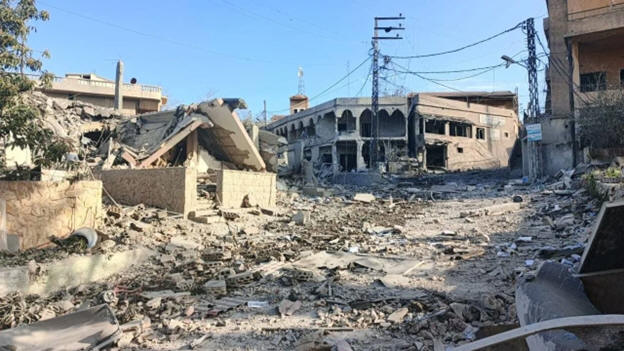
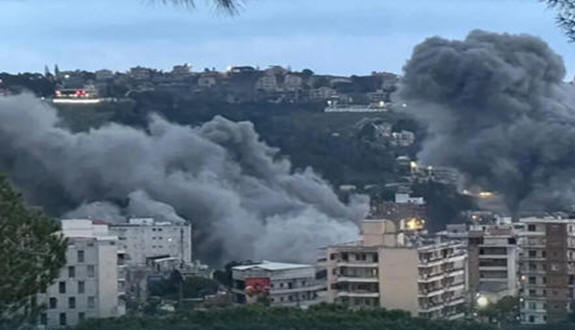
Site of the Israeli air strike on the town of Ma'raka, part
of the ongoing Israeli aggression on South Lebanon, which
resulted in the martyrdom of 14 civilians and injuring
dozens of others, April 12, 2026
Site of the Israeli air strike on the town of El-Nabatiyeh,
part of the ongoing Israeli aggression on South Lebanon,
which resulted in the martyrdom of 14 civilians and injuring
dozens of others, April 12, 2026

303 Lebanese civilians were massacred and 1,150 were injured
in the brutal Israeli air strikes on Lebanon, on April 9,
2026.
The Lebanese death toll as a result of the brutal ongoing
Israeli air strike, since March 2, 2026, rose to
1,953 martyrs and 6,303 injured civilians, by April 10, 2026
14 Lebanese Massacred, Which
Brings the Death Toll, as a Result of the Ongoing Israeli
Air Strikes, to 1,967 martyrs and More than 6,303 injured
civilians, by April 12, 2026
***
Shocking numbers... The high death toll and the worsening displacement in Lebanon (photo)
Lebanon Debate, April 10, 2026
The Disaster Risk Management Unit at the Grand Serail issued the daily report on the current situation on 10 April 2026, including an updated toll of displaced people, human casualties and hostilities in various areas.
The report stated that the number of shelters opened reached 684, while the total number of IDPs residing in them reached 140,447, distributed among 36,735 families.
With regard to hostilities, the report recorded 6,666 incidents, an indication of the continued escalation.
In terms of human losses, the number of martyrs in the daily census reached 65 martyrs, in addition to 211 wounded.
In the cumulative toll, the number of martyrs rose to 1,953 and the wounded to 6,303.
أرقام صادمة… ارتفاع حصيلة الشهداء وتفاقم النزوح في لبنان (صورة) - Lebanon Debate - ليبانون ديبايت
***
Lebanese Ministry of Health: The death toll from Israeli airstrikes on Wednesday has risen to 303
BEIRUT, April 9, 2026 (Xinhua) --
The Lebanese Ministry of Health announced on Thursday that the toll of Israeli airstrikes on the country rose to 303 dead and 1,150 wounded, in an indefinite tally.
The ministry's Health Emergency Operations Center said in a statement that "the Israeli enemy's raids on Wednesday led to an indefinite toll of 303 martyrs and 1,150 wounded," according to Lebanon's official National News Agency.
The statement added that "the operations to recover the martyrs from under the rubble are still continuing in more than one place, in addition to identifying many of the martyrs whose bodies were transferred to hospitals by conducting DNA tests."
According to the statement, the total toll of Israeli attacks since March 2 has risen to 1,888 dead and 6,092 wounded.
Earlier, Lebanese Information Minister Paul Morcos said in a statement after a cabinet meeting that the initial toll of Israeli airstrikes yesterday reached 203 dead, 33 missing and 1,072 wounded.
Israel on Wednesday launched its heaviest strikes on Lebanon since the current round of conflict with Hezbollah erupted, hours after a two-week truce between the United States and Iran was announced.
Both Israel and the United States have confirmed that Lebanon is not included in the truce, while Iran asserts that Lebanon is part of the ceasefire agreement and demands a halt to Israeli attacks on Lebanon as a condition for continuing negotiations.
Since the beginning of March, Lebanon has been witnessing a military escalation against the backdrop of the war between the United States and Israel on the one hand, and Iran on the other.
Hezbollah engaged in this war by firing rockets from southern Lebanon towards Israel on March 2 for the first time since the ceasefire was declared on November 27, 2024, and Israel responded by launching a military campaign targeting Beirut, its southern suburbs and other areas, while carrying out incursions into southern Lebanon.
وزارة الصحة البنانية: ارتفاع عدد قتلى الغارات الإسرائيلية الأربعاء إلى 303
***
The Israeli occupation continues its attacks in southern Lebanon. And more than 10 martyrs in Maroub and Qana
Al-Mayadeen Net, April 12, 2026
The Israeli occupation continues to launch violent attacks on villages and towns in southern Lebanon, and commits massacres in Qana and Ma'aroub.
Al-Mayadeen's correspondent in southern Lebanon reported that 6 citizens were killed and others were injured as a result of the Israeli aggression that targeted the town of Maaroub on Sunday morning.
At dawn today, the Israeli occupation launched a violent fire belt targeting the Al-Khashna area in the town of Qana in southern Lebanon, targeting a number of houses and infrastructure, which led to the death of 5 Lebanese and the injury of others.
The raids left extensive destruction in the area, while civil defense teams and bulldozers worked to open the road and remove the rubble.
An Israeli drone strike targeted a motorcycle in the southern Lebanese city of Soor (Tyre).
The Israeli occupation launched a violent raid on Al-Bazouriyah and two friends in the district of Soor (Tyre), and an enemy raid targeted an agricultural room between El-Habariya and Shabaa.
The town of Al-Qilila in the district of Tyre was subjected to an enemy raid, and Israeli warplanes raided the town of Qalawiya in Bint Jubail.
The enemy planes launched a raid on the town of Bafleh in the district of Sayda (Tyre), the area of Nabi Omran in the town of El-Qilila, and on El-Shihabiya and Ma'arka.
In addition, at dawn today, Israeli warplanes launched an airstrike on the town of Bariq in the district of Nabatiyeh, and carried out a series of raids targeting the towns of Sarbeen and 'Haris in two batches, and also targeted Kafra and Khirbet Salam in the district of Bint Jubail.
At night, the outskirts of the 'Hilla farm on the outskirts of the town of Kfar Shuba were hit by a raid, while the road connecting the towns of Shab'a and El-Habariya was also hit by a raid, amid reports of road closures, according to the National News Agency.
Two consecutive raids destroyed a house in the town of Shab'a, in conjunction with artillery shelling at night on the outskirts of the town of Shab'a, and a combing operation with machine guns sourced from the radar site.
And yesterday, 8 citizens were killed and 9 others were injured in a massacre committed by the Israeli occupation A car was targeted in the town of Tuffahta in the southern district of Saida.
The hostile Israeli raids on the south affected medics, as the occupation targeted a point of the Islamic Health Authority in the town of Al-Majdal.
The occupation targeted the towns of: El-Bisariyya, Tabna, Siddiqeen, El-Kafour, Zoatar El-Gharbiya, Tibneen, El-Qila, Qana, Majdal Zoan, El-Mansouri, Dibbeen, Joya, Shamma, and Mazra'at 'Hilta.
This comes in light of the continued violation of the ceasefire declaration between Iran and the United States, which was one of the most prominent clauses of which was to include Lebanon and all the fronts of the Axis of Resistance, which was confirmed by Iran and the Pakistani announcement of the agreement, but Washington and the occupation evaded their commitments.
الاحتلال الإسرائيلي يواصل اعتداءاته جنوب لبنان.. وأكثر من 10 شهداء في معروب وقانا | الميادين
***
Lebanon: 13 Martyrs of State Security Officers in Israeli Aggression Targeting the Serail in Nabatieh
Al-Mayadeen Net, April 10, 2026
The Israeli occupation continues its attacks on Lebanon, targeting the government building (El-Saray) in the city of El-Nabatiyeh, which resulted in 13 martyrs among the members of the State Security Agency.
Al-Mayadeen's correspondent in southern Lebanon reported on Friday that 13 martyrs and wounded members of the State Security Agency were killed as a result of an Israeli aggression that targeted the government building (El-Saray) in El-Nabatiyeh, in a dangerous escalation that affected official institutions.
In a related context, our correspondent pointed out that the occupation "army" carried out bombing operations in a number of southern villages, in parallel with a series of airstrikes and artillery shelling that targeted various areas.
The attacks included a raid on a new civil defense point in the town of Siddiqeen, in addition to targeting the road of the Ras El-'Ain monastery and El-Hoash area in the district of Soor (Tyre).
The south also witnessed a series of raids on the areas of El-Nabatiyeh, specifically in Dair El-Zahrani, Kafr El-Rumman and Qaqiyat El-Jisr, while the town of Sareefa in the district of Soor (Tyre) was subjected to artillery shelling.
An Israeli strike also targeted the city of Bint Jubail.
The Israeli aggression extended to the Biqaa', where it targeted the towns of Duras and Sa'hamar, which led to the death of 3 martyrs.
This aggression comes in light of Israel's continuous violation of the ceasefire declaration between Iran and the United States, one of the most prominent clauses of which was to include Lebanon and all fronts of the Axis of Resistance, which was confirmed by Iran and the Pakistani announcement of the agreement, but the occupation has once again evaded its commitments.
لبنان: 13 شهيداً من عناصر أمن الدولة بعدوان إسرائيلي استهدف السراي الحكومي بالنبطية | الميادين
***
Domicide in Lebanon: 'Israel' demolishes entire southern villages
By Al Mayadeen English Source: The Guardian
April 12, 2026
Entire villages in South Lebanon have been wiped out in what experts describe as a pattern of domicide, as Israeli occupation forces continuously commit unprecedented levels of war crimes.
The Israeli occupation has demolished entire villages in southern Lebanon as part of its ongoing border offensive, using remotely triggered explosives to level homes in mass detonations that have left residents describing their communities as erased.
Videos reviewed by The Guardian show Israeli forces carrying out controlled explosions in the villages of al-Taybeh, Naqoura, and Deir Seryan along the Lebanon-Palestinian border. Lebanese media have reported additional detonations in nearby border towns, though satellite verification was not always available.
The destruction followed statements by "Israel’s" War Minister, Israel Katz, who called for the demolition of “all houses” in border villages, referencing what he described as the “model used in Rafah and Beit Hanoun in Gaza” to prevent threats to northern "Israel". In Gaza, Israeli operations have previously destroyed an estimated 90% of homes in Rafah.
Rights groups and legal experts have described the tactic as part of a broader pattern of “domicide”, the systematic destruction of civilian housing that renders entire areas uninhabitable.
South Lebanon and Gaza, two sides of the same victim
Israeli occupation forces keep framing attacks on civilian infrastructure and residences as targeting "Hezbollah infrastructure", including tunnels and military facilities allegedly embedded within civilian areas and homes. This falls into the repeated fashion of their false claims in Gaza and how all of Gaza's buildings, including hospitals, are "Hamas headquarters".
"Israel" has also announced plans to maintain control over large parts of southern Lebanon, establishing a “security zone” extending to the Litani River. Under this plan, displaced residents would not be permitted to return until "Israel" decides that northern settler communities are secure, raising concerns of prolonged or permanent displacement.
Rights organizations, however, have warned that the destruction may constitute unlawful “wanton destruction” under international law, which prohibits the deliberate targeting of civilian property unless strictly required for military operations.
“The possibility that Hezbollah may use some civilian structures in Lebanon’s border villages for military purposes does not justify the wide-scale destruction of entire villages along the border,” said Ramzi Kaiss, Lebanon researcher at Human Rights Watch.
Coordinated destruction of villages
The footage reviewed shows synchronized demolitions flattening residential areas and public spaces, with entire neighborhoods collapsing in seconds. Residents say the destruction has erased not only buildings, but entire histories tied to their homes and land.
Ahmad Abu Taam, a 56-year-old shop owner from El-Taybeh, told The Guardian that he watched the town square, where his business was located, being destroyed.
“The first thing we saw was the town square being blown up. I have a shop there. A person’s whole life is in that place, their work, their memories, everything. Suddenly you see it exploding in front of you,” he said. “From that moment, I felt that I had become a refugee. I feel like I have no home.”
Abu Taam had previously been displaced during the 2024 Israeli war on Lebanon and had returned to rebuild his business after earlier damage. He said that returning once felt like recovery.
“When you arrive, it feels like you’ve found something you lost. But this time, everything is gone. Everything has been wiped out,” he said.
Entire life's work erased
Ahmad Ibrahim, a 50-year-old farmer from Deir Seryan, left his home on March 2, expecting to return shortly. He left behind personal belongings and family photographs, assuming he would recover them later.
“My whole life is there, I’ve never really left beyond 10-13km. It’s a beautiful, typical village – at least it was before the war. Its people are kind and generous,” he said.
He described how the coming of spring would normally transform the village into a place of gathering, farming, and family life, something now lost to displacement.
“The children remember the good times – spring and summer evenings, going out to the fields, collecting flowers and herbs, having dinner outdoors, making tea over a fire,” he said.
In Naqoura, physician and hotel owner Mohammed Hashem described the destruction of the Luna motel, which he built over 15 years and opened in 2012. The hotel had hosted tourists, Lebanese holidaymakers, and UN peacekeepers stationed in the area.
“In summer, occupancy would reach 100%. We received good ratings and awards. Overall, we were happy – living peacefully, with good productivity,” he said. “It really was a family business.”
Hashem said he was overwhelmed by messages of support after news of the hotel’s destruction circulated online.
“We received thousands of likes and comments. People expressed how much they loved the place. Our guests were always happy – good prices, good service,” he said.
Southern heritage
The villages of southern Lebanon have long been shaped by cycles of war and displacement dating back to the late 1970s. Over time, they became symbolic anchors for a global diaspora spread across Australia, Africa, and Europe.
Families would return seasonally, often rebuilding large homes for short stays during summer and spring, reinforcing emotional and cultural ties to the land.
“People would build houses worth a million dollars just to stay for a week or 10 days a year. The village becomes the centre of the family,” Abu Taam said.
Now, many of those anchors no longer exist.
“You feel a deep sense of frustration. Like someone has the power to erase you,” he said.
Domicide in Lebanon: 'Israel' demolishes entire southern villages | Al Mayadeen English
***
Fair Use Notice
This site contains copyrighted material the
use of which has not always been specifically authorized by the copyright
owner. We are making such material available in our efforts to advance
understanding of environmental, political, human rights, economic,
democracy, scientific, and social justice issues, etc. We believe this
constitutes a 'fair use' of any such copyrighted material as provided for
in section 107 of the US Copyright Law. In accordance with Title 17 U.S.C.
Section 107, the material on this site is
distributed without profit to those
who have expressed a prior interest in receiving the included information
for research and educational purposes. For more information go to: http://www.law.cornell.edu/uscode/17/107.shtml.
If you wish to use copyrighted material from this site for purposes of
your own that go beyond 'fair use', you must obtain permission from the
copyright owner./font>
|
||||||||||||||||